
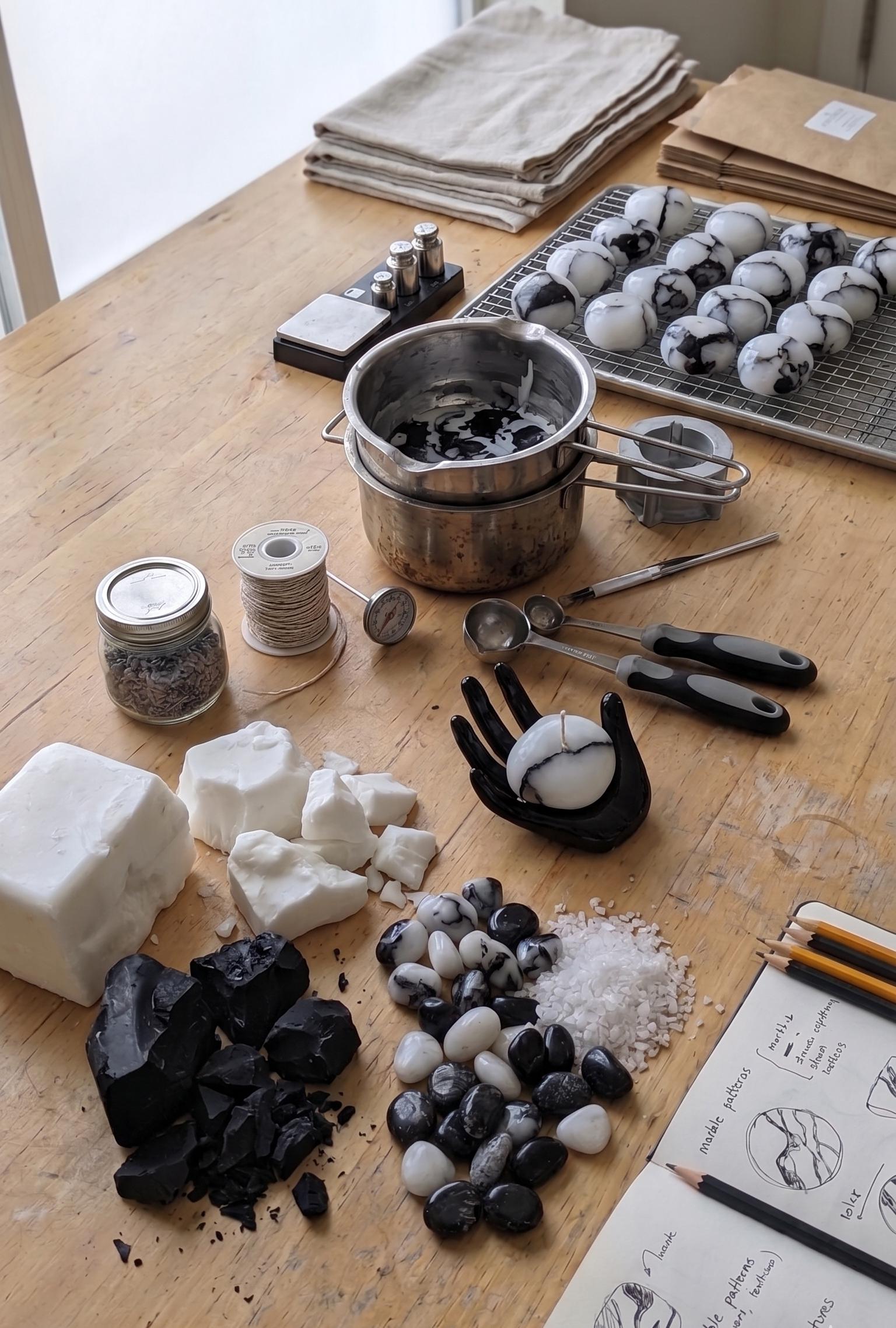
Behind the Scenes — What Goes Into Making a Stone Candle
A full production cycle for stone candles takes 6 to 12 hours — from melting the wax to the final lacquer coat before curing. No molds, no machines, no shortcuts — just a maker's hands, warm wax, and the craft of shaping something that looks like it was formed by a river, not by a person. This article is not a tutorial. SHAKHOV's stone candle making process is a proprietary craft — the specific techniques, temperatures, timing, and methods are taught exclusively through our professional video masterclass available on Etsy. What this article offers instead is a look behind the scenes: the philosophy, the materials, the standards, and the challenges that go into every stone candle.
The Materials
Every SHAKHOV stone candle starts with the same raw materials: Food-grade paraffin P2 and natural waxes. This specific blend was developed through extensive testing. Food-grade paraffin P2 is refined to a higher standard than industrial paraffin — it burns cleaner with fewer impurities. The natural waxes in the blend contribute surface characteristics: the crystalline patterns and organic textures that make each candle resemble natural stone. The ratio and the way the waxes are combined are part of the proprietary process. Reinforced wicks. Cotton wicks with a thin supporting core that keeps them standing upright in the melt pool from the first burn to the last. The wick does not sink, bend, or collapse — even in the wide, flat geometry of a stone candle with a large melt pool. Each candle size uses a specific wick size, calibrated through burn testing. Three layers of sealing lacquer. Applied to the finished candle surface to prevent wax from leaking through. This is not cosmetic — the lacquer is a functional seal. If it is mechanically damaged (scratched, chipped), wax can escape through the opening. This is why we always recommend using a SHAKHOV candle tray underneath. These materials are not exotic or secret. What makes stone candles unique is not the ingredients — it is what happens when a skilled maker works with them.
The Principle: No Molds
The defining characteristic of SHAKHOV stone candles — the thing that separates them from every other candle product — is that they are shaped entirely by hand, without any mold. Most "handmade" candles use silicone molds. The maker pours liquid wax into a predetermined shape, waits for it to cool, and pops it out. The skill is in formulation and pouring — but the form is dictated by the mold. Every candle from the same mold is identical. Stone candles have no mold. The maker shapes warm, pliable wax with their hands — pressing, smoothing, rotating, and refining until the candle has the organic, asymmetrical form of a river stone. No template, no guide, no two results alike. This is why the process takes hours, not minutes. And it is why no two stone candles are ever the same — even when made by the same person on the same day.
The Challenge: Making Something Look Natural
Here is the paradox of stone candle making: the hardest part is making the candle not look handmade. A natural river stone has no straight lines, no geometric regularity, no visible tool marks. It has been shaped by water over thousands of years into something that looks effortless. Replicating that quality — that sense of natural accident — is a learned skill. Beginning candle makers instinctively symmetrize. They smooth too evenly. They create shapes that look polished and deliberate — which is exactly what a stone should not look like. The skill lies in restraint: knowing when to stop shaping, where to leave asymmetry, how to create irregularity that reads as natural rather than careless. This is why SHAKHOV stone candles look convincing enough that people pick them up and turn them over before realizing they are holding a candle, not a stone. That reaction — the moment of surprise — is the result of craft, not of materials.
Quality Standards
Every stone candle goes through inspection before leaving the workshop. The checklist: Form. Does it look like a convincing stone? Does it sit flat and stable? Is the weight distribution balanced? Surface. Is the finish consistent — smooth where it should be smooth, textured where it should be textured? Are there cracks, bubbles, or unintended roughness? Wick. Is it centered correctly within the candle's asymmetrical shape? Is it the right size for this candle's diameter? Lacquer. Are all three layers intact? Is the seal complete — no gaps, no thin spots, no damage? Candles that do not pass inspection are melted down and the wax is recycled. This waste is built into the process. Not every attempt produces a candle that meets the standard, and that is acceptable — it is how quality is maintained without molds to guarantee uniformity.
Curing: The Invisible Step
After shaping, wicking, and lacquering, every candle enters a curing phase — 24 to 48 hours of rest at room temperature. During curing, the wax crystallizes into its final molecular structure. This affects burn quality, surface hardness, and flame stability. A candle burned before proper curing will underperform: shorter burn time, less stable flame, potential surface issues. Curing cannot be accelerated. Heat, forced air, or any shortcut compromises the crystal structure. The candles simply wait. This is one of the invisible differences between craft production and factory production. A factory optimizing for speed ships candles the day they are made. A craft workshop gives them the time they need.
Packaging as Part of the Craft
The final stage is packaging — and it is done with the same care as the candle itself. Each candle is wrapped individually in soft paper to protect the lacquer. The wrapped candles are nestled into dried Mediterranean herbs and grasses — natural cushioning that also creates the unboxing experience customers love. For orders with a bamboo gift box (a separate option indicated in the product listing), the candles are arranged inside with intention — which candle goes where, how the shapes relate to each other, how the herbs frame them. This is a person making aesthetic decisions, not a machine filling a box.
The Production Cycle
One full cycle — melting, blending, shaping, setting wicks, applying three coats of lacquer with drying between each — takes 6 to 12 hours. At full capacity, SHAKHOV produces up to 1,000 candles per month — each one hand-shaped, each one inspected, each one unique. The cycle cannot be compressed. Each stage depends on the previous one completing properly. Rush the wax temperature and the shaping fails. Skip drying time between lacquer coats and the seal is compromised. Cut the curing short and burn quality suffers. Human to Human means every cycle takes as long as it needs to produce candles that meet the standard.
Want to Learn the Process?
If you are a candle maker, a DIY enthusiast, or someone who wants to host stone candle workshops, SHAKHOV offers a professional video masterclass that teaches the complete stone candle making process step by step. The masterclass includes: — Full-length video tutorial covering the entire process from raw wax to finished candle — PDF instructions with detailed notes — Techniques for hand-shaping without molds — Material specifications and sourcing guidance — Tips for achieving convincing stone textures and forms The masterclass is available as an instant digital download on Etsy: etsy.com/shop/SHAKHOV Whether you want to make stone candles for yourself, as gifts, or to sell at markets and online — the masterclass gives you the knowledge to start. SHAKHOV — handmade stone candles from Kaş, Turkey. Food-grade paraffin P2, reinforced wicks, three-layer lacquer seal. shakhov.store