
Why Small Craft Brands Are Going Global with Crypto Payments
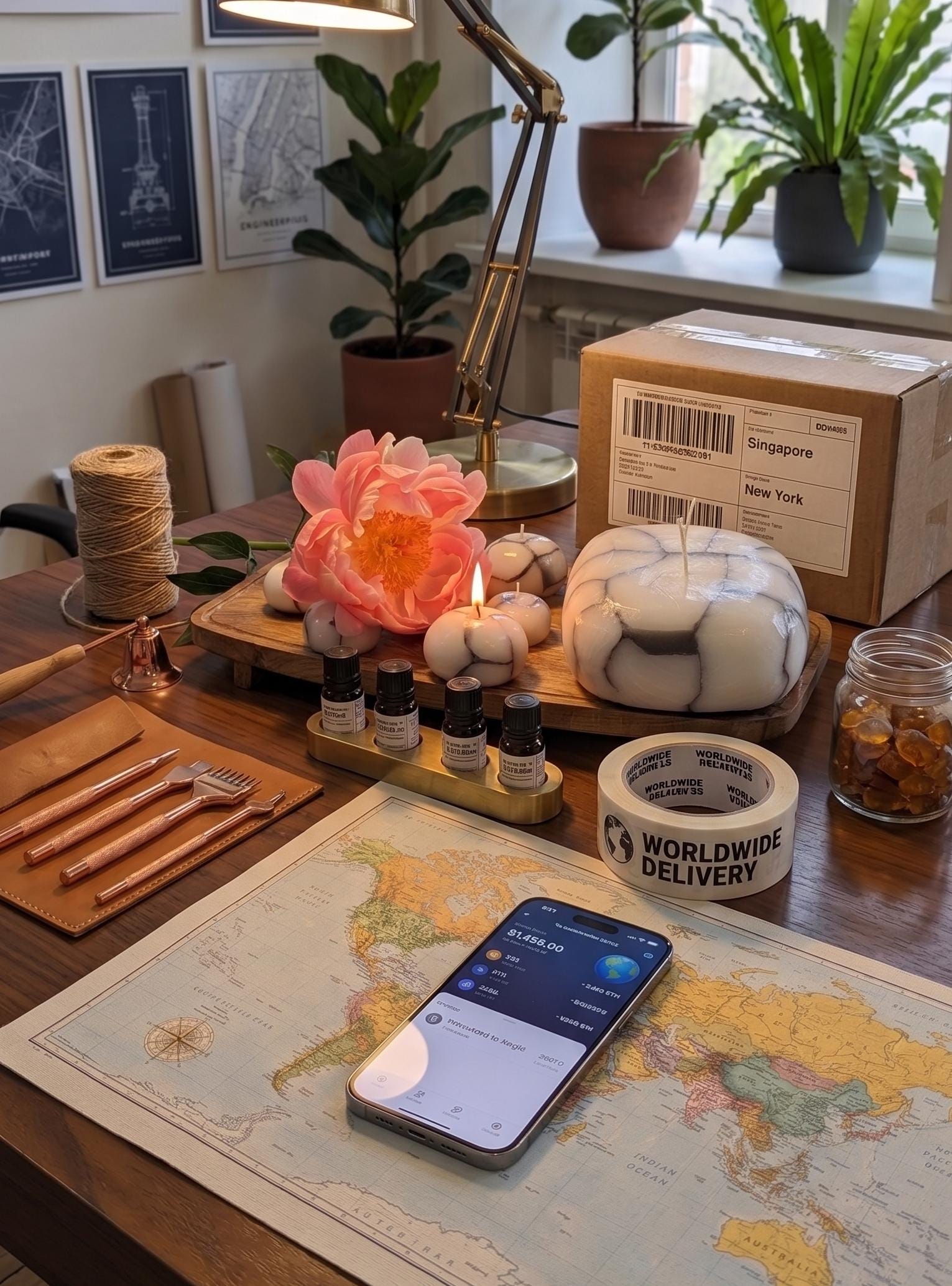
Small craft brands are adopting cryptocurrency payments to bypass the friction of international commerce: high card processing fees, currency conversion costs, and chargeback fraud. For a handmade brand shipping from Turkey to 30+ countries, crypto reduces payment processing costs from 3-4% to under 1% and eliminates the risk of fraudulent chargebacks entirely. This is not about ideology or speculation. It is about practical economics. When your margin on a handmade product is already thin — because materials are expensive, labor is slow, and you cannot compete on volume — every percentage point in payment fees matters. Crypto is a tool that solves real problems for small international sellers. This article explains why crypto payments make particular sense for artisan brands, what the actual cost savings look like, and how SHAKHOV adopted crypto for its stone candle business.
The Problem: International Payments for Small Makers
Selling handmade products internationally sounds simple: someone in Germany wants to buy a candle from a maker in Turkey, they pay, the candle ships. In reality, the payment infrastructure between those two people is designed for large corporations, not for a one-person workshop. Credit card fees eat margins. A typical international card transaction costs the merchant 2.9-3.5% in processing fees, plus a fixed fee per transaction ($0.30 or equivalent). On a $50 candle, that is $1.75 in fees before the product even ships. On a $15 candle, the fee percentage is effectively even higher because of the fixed component. Currency conversion adds cost. The buyer pays in euros. The merchant receives Turkish lira (or whatever their local currency is). Between those two currencies, the payment processor takes another 1-2% as a conversion spread. The buyer may also pay their bank's foreign transaction fee of 1-3%. Platform fees stack on top. If the sale happens through a marketplace like Etsy, the platform takes 6.5% in transaction and processing fees. Add card processing and currency conversion, and the total cost of a single international sale can reach 10-12% of the product price. Chargebacks are devastating. A chargeback happens when a buyer disputes a credit card charge after receiving the product. The buyer gets their money back. The merchant loses the product, the shipping cost, and pays a chargeback fee ($15-25). For a small maker, even a few chargebacks per year can wipe out a month's profit. And chargeback fraud — where the buyer intentionally files a false dispute — is a growing problem that disproportionately affects small sellers. These are not theoretical problems. They are the daily reality of running a small international craft business.
How Crypto Solves Cross-Border Payment Friction
Cryptocurrency payments address each of these problems: Lower fees. Crypto payment gateways charge 0.5-1% per transaction, with no fixed per-transaction fee. On a $50 candle, that is $0.50 instead of $1.75+. On a $15 candle, the savings are proportionally even larger. No currency conversion spread. The buyer pays in crypto. The payment gateway converts to the merchant's preferred currency (or keeps it in crypto) at market rate with minimal spread. There is no bank in the middle taking 1-2%. No chargebacks. Blockchain transactions are final. Once confirmed, they cannot be reversed by the buyer. This does not mean there is no recourse for legitimate issues — responsible merchants handle refunds manually when warranted — but it eliminates the fraudulent chargeback problem entirely. No geographic restrictions. A buyer in any country with internet access can pay with crypto, regardless of their local banking infrastructure, card availability, or currency controls. This is especially relevant for buyers in countries where international card payments are restricted or expensive. Instant settlement. Card payments can take 2-7 business days to settle into the merchant's account. Crypto settles in minutes. For a small business with limited cash flow, faster access to funds matters.
Real Costs: Card Fees vs. Crypto Fees
Let's look at a real example using a typical SHAKHOV order — a gift set of 3 stone candles for $70, shipped internationally. Card payment through a marketplace: Marketplace fee (6.5%): $4.55 Payment processing (2.9% + $0.30): $2.33 Currency conversion (1.5%): $1.05 Total fees: $7.93 (11.3% of the sale) Card payment through own website: Payment processing (2.9% + $0.30): $2.33 Currency conversion (1.5%): $1.05 Total fees: $3.38 (4.8% of the sale) Crypto payment: Gateway fee (0.5%): $0.35 Network fee: $0.01-$2.00 (depending on chain — Solana is cents, Bitcoin can be $1-2) Total fees: $0.36-$2.35 (0.5-3.4% of the sale) The savings are clear: crypto payments cost roughly one-third to one-half of what card payments cost, even without marketplace fees. For a small brand processing hundreds of international orders per year, this adds up to thousands of dollars in saved fees.
No Chargebacks: Why This Matters for Artisans
Chargeback fraud hits small makers harder than large retailers for a simple reason: they cannot absorb the loss. A large retailer budgets for a 1-2% chargeback rate as a cost of doing business. A small maker shipping handmade candles does not have that buffer. A single fraudulent chargeback on a high-value order — say, a $200 gift set — means losing the product ($200), the shipping ($15-25), paying the chargeback fee ($20), and paying any marketplace penalties. Total loss: $235-245, plus the hours of labor that went into making those candles. With crypto, this scenario is impossible. The payment is final. If a buyer has a legitimate complaint, the maker handles it directly — refund, replacement, or resolution. But no third party can forcibly reverse the payment months after the fact based on a fraudulent claim. For makers who sell high-value handmade products internationally, this alone is a compelling reason to offer crypto as a payment option.
Privacy and Simplicity for International Buyers
From the buyer's perspective, crypto offers something that card payments do not: simplicity without data exposure. Paying with a credit card internationally means sharing your card number, name, billing address, and sometimes additional verification with the merchant's payment processor, the card network, and your bank. Each of these entities stores your data, each is a potential breach point. Paying with crypto means scanning a QR code and confirming in your wallet. No card numbers shared. No personal data exchanged. No bank involved. For privacy-conscious buyers — and the crypto community tends to value privacy — this is a significant advantage.
SHAKHOV's Path to Accepting Crypto
SHAKHOV began as a handmade stone candle brand selling primarily through Etsy and Russian marketplaces. As international orders grew, the friction of cross-border payments became increasingly apparent: high fees, slow settlements, occasional chargebacks, and the inability to serve buyers in countries with limited card infrastructure. Adding crypto payments was a practical decision, not a philosophical one. The setup took less than a day. The ongoing costs are lower. The payment experience for international buyers is smoother. And the chargeback risk dropped to zero. The most unexpected outcome was that crypto attracted a new audience — buyers from the crypto community who specifically seek out physical products they can purchase with their digital assets. A handmade stone candle from Turkey, purchased with Solana and shipped as a gift — this combination has a certain appeal that resonates with people who live in the digital economy but value tangible, human-made objects. SHAKHOV now accepts Bitcoin, Ethereum, USDT, USDC, Solana, and 300+ other cryptocurrencies. Payments are processed through a payment gateway with automatic conversion. The process is simple: buyer contacts us, we send a payment link, they scan and pay, we ship.
The Future of Craft Commerce
Crypto payments are not replacing credit cards or marketplaces. They are adding a channel — one that is particularly well suited to small, international, handmade businesses. The brands most likely to benefit are those selling high-touch, high-value products to an international audience: ceramicists, woodworkers, textile artists, jewelers, and yes, candle makers. These are the businesses where margins are thin, international reach is essential, and every percentage point in fees affects viability. As crypto wallets become more mainstream and payment gateways become easier to integrate, more small makers will add crypto alongside their existing payment methods. Not instead of — alongside. The goal is not to be a "crypto brand." The goal is to sell handmade products with the least friction possible, to the widest audience possible. For SHAKHOV, crypto is simply another way to fulfill the brand's core mission: getting handmade stone candles from a workshop in Kaş, Turkey, into homes around the world. Human to Human — with a blockchain in between. SHAKHOV — handmade stone candles from Kaş, Turkey. We accept crypto. shakhov.store | WhatsApp/Telegram: +905310135921