
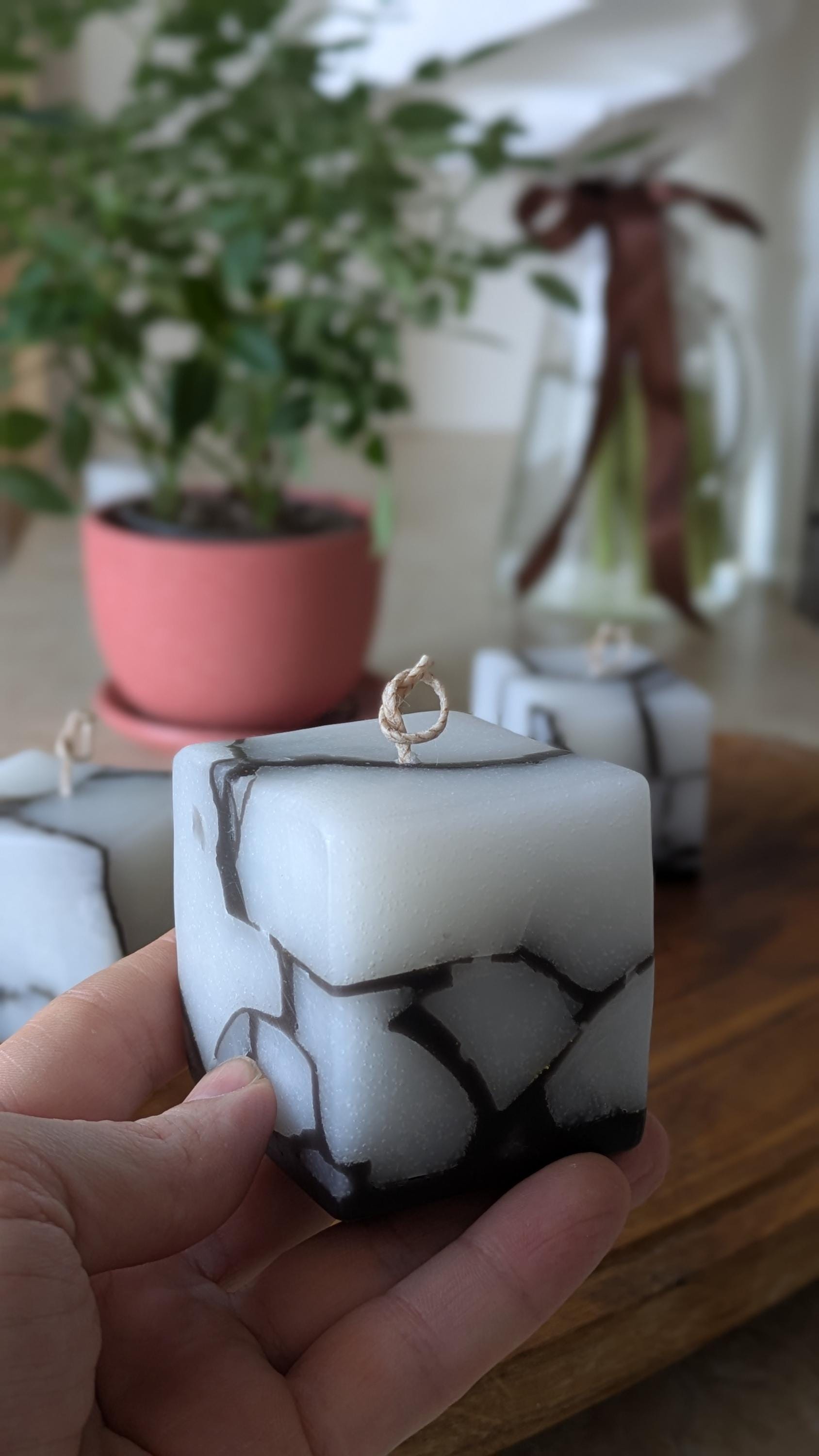
How to Use and Care for Stone Candles — The Complete Guide
Stone candles burn best when you follow three simple rules: let the entire surface melt on the first burn, trim the wick to 3-5mm before each use, and extinguish by dipping the wick rather than blowing. This prevents tunneling, extends burn time, and keeps the flame clean and soot-free. Stone candles are not fragile, but they are handmade objects with specific characteristics. Understanding how they work — and what makes them different from jar candles or tapers — will help you get the longest burn time, the cleanest flame, and the most enjoyment from each candle. This guide covers everything: first burn, daily use, extinguishing, outdoor burning, floating on water, storage, and troubleshooting.
The First Burn — Why It Matters More Than Any Other
The single most important moment in a stone candle's life is its first burn. What happens during the first burn determines how the candle will perform for every burn after that. Here is why: wax has memory. When you light a candle for the first time, the wax melts outward from the wick, creating a pool of liquid wax called the melt pool. If you extinguish the candle before the melt pool reaches the edges — before the entire top surface has become liquid — the wax forms a "memory ring." On every subsequent burn, the melt pool will only extend as far as it did the first time, creating a tunnel that burns straight down through the center while leaving a thick wall of unmelted wax around the sides. This is called tunneling, and it is the number one reason candles underperform. It wastes wax, shortens burn time, and can eventually drown the wick in a deep well of melted wax. How to do the first burn correctly: Light the candle and let it burn until the entire top surface is liquid wax from edge to edge. For a small (S-size) stone candle, this takes about 45 minutes to 1 hour. For medium (M-size), about 1 to 1.5 hours. For large (L-size) or XL, it can take 1.5 to 2.5 hours. Yes, this means you need to plan your first burn. Don't light a stone candle for the first time if you only have 20 minutes. Wait until you have an evening where you can let it burn properly. This one investment of time will pay off across the entire life of the candle. What if tunneling has already started? If you made the mistake of extinguishing too early on the first burn and tunneling has begun, you can sometimes fix it. Light the candle and use a piece of aluminum foil to create a loose dome over the top, leaving a small opening for airflow. The foil reflects heat back onto the wax walls, helping them melt and reset the memory ring. This takes patience — sometimes 2-3 hours — but it can save a tunneling candle.
How to Trim the Wick
Trimming the wick is the second most important habit for getting the best performance from a stone candle. It takes five seconds and makes a significant difference. Before every burn, trim the wick to 3-5mm (about 3/16 to 1/4 inch) above the wax surface. You can use a dedicated wick trimmer, small scissors, or even nail clippers. Why this matters: A wick that is too long produces a flame that is too large. A large flame burns too hot, which causes several problems at once: it consumes wax faster than necessary (reducing total burn time), it produces soot (the black carbon particles that can stain walls and ceilings), and it creates an unstable, flickering flame that looks less beautiful and can drip. A properly trimmed wick produces a steady, calm, clean flame. The flame height should be about 2-3cm (roughly an inch). If you see the flame dancing wildly, flickering constantly, or producing a visible stream of black smoke — the wick is too long. What about the wick debris? After trimming, remove the cut piece of wick from the candle surface. If it falls into the wax pool during burning, it can create a secondary ignition point or clog the melt pool. A quick flick with tweezers or fingers (before lighting) keeps the surface clean. Can a wick be too short? Yes. If you trim below 3mm, the flame may be too small to create a proper melt pool, and the candle may extinguish itself. If this happens, carefully pour out a small amount of the melted wax to expose more wick, then relight.
How to Extinguish a Stone Candle
This is where most people make a mistake: they blow out the candle. Blowing works, but it's the worst method. Here are three better ways, ranked from best to acceptable. Method 1: Wick dipping (best) Using tweezers, a toothpick, or a wick dipper tool, gently push the lit wick down into the melted wax pool. The wax immediately extinguishes the flame — no smoke, no smell, no soot. Then lift the wick back upright so it's ready for the next use. This method has a bonus: the wick gets coated in a thin layer of wax, which makes it easier to light next time and produces a cleaner initial flame. Method 2: Candle snuffer Place a candle snuffer (the bell-shaped tool on a handle) over the flame. It cuts off oxygen and extinguishes the flame with minimal smoke. More elegant than blowing, less effective than dipping. Method 3: Lid or plate If you don't have a snuffer or tweezers, place a heat-safe plate or lid over the candle to cut off airflow. This works but can trap smoke inside. Why not blow? Blowing produces a burst of smoke and scent that fills the room with the smell of extinguished candle — that acrid, waxy smell everyone recognizes. It also spatters tiny droplets of hot wax, can bend or displace the wick, and sometimes sends burning ember particles onto nearby surfaces. For a candle you care about, dipping is always better.
How Long Should You Burn a Stone Candle Per Session?
The recommended maximum burn time per session is 3 to 4 hours. After 3-4 hours of continuous burning, the wax pool becomes very deep and hot. This causes two problems: the wick can become unstable (tilting, mushrooming, or producing excess soot), and the base of the candle can become warm enough to potentially affect the surface underneath. After each session, extinguish the candle (using the methods above) and let it cool completely before relighting. "Completely" means the wax has fully re-solidified and the candle is cool to the touch — usually 1-2 hours. The minimum per session is also important: burn long enough for the full melt pool to form. For S-size, that's at least 30-45 minutes. For larger sizes, at least an hour. Short burns (10-15 minutes) are worse than no burn at all, because they create micro-tunnels. Summary of ideal burn times per session: S-size: 45 minutes to 2 hours M-size: 1 to 3 hours L-size: 1.5 to 3.5 hours XL-size: 2 to 4 hours
Using Stone Candles Outdoors
Stone candles are naturally suited for outdoor use — more so than almost any other candle type. Their low, wide, heavy shape gives them a low center of gravity that resists tipping from wind or accidental bumps. The flame sits in a protected well of melted wax, shielded by the candle's own mass. This means a stone candle can stay lit in moderate breezes that would instantly extinguish a taper or pillar candle. Best outdoor settings: Dinner tables on patios and terraces — stone candles won't drip onto food or tablecloths. Garden paths — a line of stone candles along a walkway creates a dramatic effect after dark. Poolside — both on the deck and floating in the water. Balconies — the wind resistance makes them practical where other candles fail. Wind limits: Stone candles handle light to moderate wind well. In strong, sustained wind (the kind that makes napkins fly off the table), even a stone candle will struggle. If the flame is flickering violently and bending flat, it's too windy — extinguish and wait for calmer conditions. Surface protection outdoors: On wooden deck tables or painted surfaces, still use a plate or tray underneath. The lacquer coating protects against wax leakage, but outdoor surfaces can be more heat-sensitive than indoor furniture.
Using Stone Candles as Floating Candles
One of the most striking ways to use stone candles is on water. Wax is naturally lighter than water, so any stone candle that is wider than it is tall will float stably on the surface with the wick pointing up. How to do it: Place the candle gently on the water, flat side down. Wait a few seconds for it to stabilize and stop rocking. Light the wick once the candle is sitting still. S-size and M-size stone candles are ideal for floating because their flat, pebble-like proportions give them excellent stability on water. L-size and XL can also float but need a larger water surface area to accommodate them. Best settings for floating stone candles: Swimming pools — group 5-10 candles in a calm area away from jets and filters. Large decorative bowls — a wide ceramic or glass bowl filled with water and 3-5 floating stone candles makes a stunning table centerpiece. Bathtubs — 2-3 floating stone candles transform a bath into a spa experience. Garden ponds and fountain basins — the reflection of flame on water creates a memorable visual. Event settings — weddings, dinners, and receptions use floating candles frequently for dramatic effect. Practical notes: The water keeps the wax cooler around the edges, which can slightly extend burn time compared to burning on a solid surface. The protective lacquer coating is not necessary for floating use — water itself prevents wax from spreading — so you can remove it for a more natural matte look if you prefer. Ensure the water surface is calm. Waves, splashing, or strong wind across the water surface can extinguish the flame or tip the candle. In pools, position candles in a sheltered corner away from return jets.
How to Store Stone Candles
Stone candles are robust, but proper storage keeps them in perfect condition: Temperature: Store below 45°C (113°F). High heat can soften the wax, potentially deforming the candle's shape. A normal room temperature environment is fine. Sunlight: Avoid prolonged direct sunlight. UV exposure can cause the natural wax color to yellow over time and may soften the surface. A shelf, drawer, or closed cabinet is ideal. Humidity: Not a major concern for wax, but very high humidity environments can cause condensation on the lacquer surface. Wipe dry before use. Original packaging: The gift box with dried herb bedding and paper wrapping is the ideal storage solution. It protects the candle from dust, light, and minor impacts. Dust: If a candle has been sitting out unlit for a long time, it may collect dust. Wipe gently with a soft, dry cloth. Avoid water or cleaning products on the wax surface.
Troubleshooting Common Issues
The candle is tunneling. The first burn was too short. Try the aluminum foil dome method described above. If the tunnel is very deep (more than halfway down), the candle may be difficult to save — burn it in shorter sessions and manually scoop out some of the inner liquid wax to level the surface. The flame is too large and flickering. The wick is too long. Extinguish, let cool, trim the wick to 3-5mm, and relight. The candle produces black soot. Same cause — the wick is too long. Trim it. Also check for drafts: a candle in a strong airflow (near a window, fan, or AC vent) will flicker and produce soot regardless of wick length. The candle won't stay lit. The wick may be too short (over-trimmed), or there is wax debris around the wick base. Clear any debris, and if the wick is buried in wax, carefully pour out some melted wax to expose more wick. The candle has white spots on the surface. This is "frosting" — a natural characteristic of palm wax. It is cosmetic only and does not affect performance. It often appears after temperature changes (shipping, storage in a cold room). It is not a defect. The candle leans or is uneven. Stone candles are hand-shaped, so very minor asymmetry is normal. If a candle doesn't sit flat, gently warm the base with a hairdryer on low heat and press it against a flat surface to level it.
Quick Reference Card
First burn — let the full surface melt (45 min – 2.5 hrs). Prevents tunneling forever. Trim wick — to 3-5mm before every burn. Clean flame, less soot, longer burn. Extinguish — dip wick into wax pool. No smoke, no smell, easy relight. Session length — 45 min minimum, 4 hrs maximum. Full melt pool without overheating. Storage — below 45°C, out of direct sun. Preserves shape and color. Outdoors — use on stable surface with tray. Wind-resistant, drip-free. Floating — place flat-side down on calm water. Wider than tall = stable float. SHAKHOV — handmade stone candles from Kaş, Turkey. Human to Human. Browse the collection at shakhov.store.